

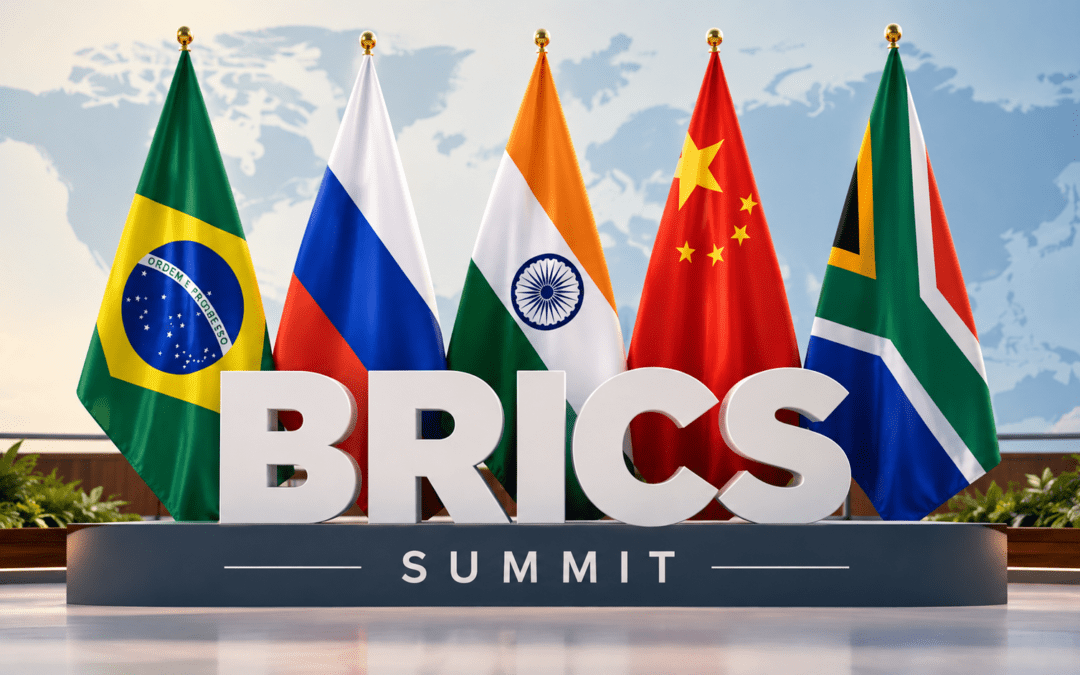
This year, India assumes the presidency of BRICS, which is significant for the timing. The country will be hosting the 18th BRICS Summit in New Delhi between September 12 and 13, 2026, with the topic defined as “Building for Resilience, Innovation, Cooperation and Sustainability.” ” It’s a significant moment on India’s diplomatic calendar, and one that carries implications well beyond the summit hall itself.
In the run-up to the main event, India’s chairship year has already featured a series of BRICS-related gatherings — among them the BRICS Young Diplomats Forum and the BRICS Urbanisation Forum, both held in New Delhi. These sit alongside ministerial-level discussions covering trade, finance, technology and sustainable development, giving 2026 a fuller BRICS Summit calendar than a single two-day summit might suggest.
For businesses watching from the sidelines, the interesting part isn’t the diplomacy itself — it’s what a summit like this does to search behaviour and public attention in the weeks surrounding it. When a major international gathering puts a country and its economic priorities in the spotlight, people search differently for a while. Interest in trade relationships, export opportunities, sourcing regions and cross-border partnerships tends to rise, even among audiences who’d otherwise have no reason to think about a diplomatic BRICS summit at all.
What Is the BRICS Summit?
BRICS is a coalition of emerging and developing economies working together on shared priorities — trade, finance, technology, innovation and sustainable development among them. The grouping holds its main leaders’ BRICS summit annually, supported year-round by ministerial and working-level meetings that keep cooperation moving between summits.
It’s grown considerably since it first came together in the mid-2000s, picking up new members along the way. As things stand, the BRICS framework counts 11 member nations — Brazil, China, Egypt, Ethiopia, India, Indonesia, Iran, Russia, Saudi Arabia, South Africa and the United Arab Emirates — alongside a group of partner countries.
BRICS isn’t a trade bloc in the way the European Union is. There’s no shared currency, no single market, no unified regulatory system binding members together. It functions more as a forum — a space where countries with different political systems and economic priorities coordinate on specific issues, while each retains full control over its own domestic policy.
Membership in BRICS, on its own, doesn’t hand any company an automatic opportunity. Whether expansion into a given market makes sense still comes down to the usual factors: real demand, local regulation, how crowded the field already is, and whether a business can genuinely deliver once it gets there. What the BRICS summit does provide is context — a reason for buyers, media and researchers in these economies to be paying closer attention to cross-border trade right now.
Why the Summit Creates a Window of Opportunity
Events like the BRICS Summit tend to produce a short but real spike in search interest around a cluster of related topics. Trade cooperation, technology partnerships, manufacturing capacity, and investment opportunities across member economies all get more attention than usual, both from journalists covering the BRICS summit and from businesses trying to understand what it might mean for them.
This matters because visibility during that window can translate into genuine opportunity. A buyer researching potential suppliers in India, for instance, or a company exploring partnerships across BRICS economies, is more likely to be actively searching during a period like this than during an ordinary month. Businesses that already show up clearly in those searches — with credible, well-structured information about who they are and what they do — stand to benefit from attention that has nothing to do with luck and everything to do with being findable at the right moment.
This is where global search trends and brand opportunity start to overlap. It isn’t about publishing something the week of the BRICS summit and hoping for a traffic bump. It’s about the fact that summits like this shift what large numbers of people are curious about, even temporarily, and businesses with a strong existing digital presence are simply better positioned to catch that shift when it happens.
How BRICS-Driven Attention Shapes Search Behaviour
Search interest around a BRICS summit rarely stays confined to news and politics. It tends to ripple outward into more commercial territory — people searching for background on member economies, comparing trade relationships, looking into specific industries or sectors that get mentioned in coverage, or trying to understand what a particular policy discussion might mean practically.
For a business operating in or trading with a BRICS economy, this creates a real, if temporary, increase in the number of people actively curious about the space that business occupies. Someone who reads a headline about India’s chairship and BRICS trade discussions might, an hour later, be searching for Indian manufacturers, exporters or service providers in a completely unrelated tab.
None of this guarantees a sale, obviously. But it does mean the pool of people encountering information about BRICS economies — their industries, their capabilities, their trade relationships — is larger than usual for a stretch of time. Businesses with accurate, well-organised, genuinely informative content about what they do are simply more likely to be part of what those searchers find.
Why This Matters Particularly for Indian Businesses
India’s 2026 chairship puts Indian businesses in a slightly different position than companies elsewhere in the BRICS Summit group. The country isn’t just a member this year — it’s the one setting the agenda, hosting the events, and drawing a disproportionate share of the attention that comes with all of it.
For Indian exporters, manufacturers, technology companies and service providers, that’s a reasonable moment to take stock of where things stand. It doesn’t mean every business should suddenly try to court every BRICS market. It means the conditions for being noticed — genuinely, by people with real commercial intent — are a little better than usual right now, provided a business is prepared to be found.
BRICS Trade Ministers have also taken up topics like trade in services, global value chains, and ways to open up opportunities for MSMEs during this chairship — all of which reinforces the same point: attention on Indian trade and industry is elevated this year, and that attention is worth something to businesses positioned to receive it.
The Bigger Picture
The point here isn’t that businesses should rush to publish content about the BRICS Summit itself and hope for the best. That misses what’s actually going on.
The real opportunity lies in recognising that a major international gathering like this genuinely shifts what people are curious about — for weeks, sometimes longer — and that shift touches trade, industry and cross-border business in ways that go well beyond the summit’s official agenda. Businesses that already have a clear, credible, well-organised presence online are simply better placed to be part of that conversation when it happens, whether or not they ever mention BRICS by name.
Conclusion
The BRICS Summit 2026 gives businesses a useful window into how international attention moves, and what that means for anyone hoping to be found by buyers, partners or researchers looking into BRICS economies during this period.
For brands — Indian ones especially, given the country’s chairship this year — the practical takeaway isn’t to chase the news cycle. It’s to recognise that summits like this create real, if temporary, shifts in what people are searching for, and that being genuinely visible and credible during those shifts is worth more than trying to manufacture relevance after the fact.
The opportunity isn’t in being everywhere. It’s in being findable by the people who happen to be looking, right when their attention is already pointed in your direction.
Frequently Asked Questions
- What is the BRICS Summit?
It’s the main annual gathering of BRICS leaders, where member countries take up shared priorities across economics, finance, trade, technology and development. Cooperation continues throughout the year as well, through ministerial and working-level meetings. - When is the BRICS Summit 2026 happening?
India chairs BRICS for 2026 and is hosting the 18th BRICS Summit in New Delhi on September 12–13, 2026. The year’s broader calendar has already included gatherings like the BRICS Young Diplomats Forum and the BRICS Urbanisation Forum. - Where is it being held?
New Delhi is hosting the main summit, alongside several other BRICS events held across India during the country’s chairship year. - Which countries belong to BRICS?
There are 11 member countries at present: Brazil, China, Egypt, Ethiopia, India, Indonesia, Iran, Russia, Saudi Arabia, South Africa and the United Arab Emirates. - Why does the BRICS Summit matter?
It gives member nations a forum to work through shared concerns — trade, finance, technology, science, education, energy, and more — and it keeps cooperation going year-round through ministerial meetings and working groups. - What’s India’s role this year?
India holds the 2026 chairship and is coordinating the full calendar of BRICS meetings and activities, under the theme “Building for Resilience, Innovation, Cooperation and Sustainability.” - What’s on India’s BRICS 2026 agenda?
Resilience, innovation, cooperation and sustainability sit at the centre of it. The wider BRICS process continues to cover trade, technology, finance, science and innovation as well, building on themes carried over from earlier chairships. - Does BRICS Summit cooperation actually affect international business?
It can, since BRICS discussions touch on trade, investment, services, technology and broader economic cooperation. But being part of BRICS doesn’t hand any single company an opportunity automatically — each business still has to work out its own market fit, demand, regulatory picture and competition. - How does the BRICS Summit affect search trends?
Major international gatherings like this tend to produce a temporary rise in search interest around trade, industry and cross-border partnerships involving the countries in the spotlight. That shift can bring more attention to businesses operating in those economies, even if the searches themselves have nothing directly to do with the summit.